
· by Michael Blair, Nashville's Pest Control
Mice come indoors as temperatures drop, and Middle Tennessee houses give them plenty of routes. Trapping deals with the individuals present; exclusion is what stops the next ones.
How little space they need
A mouse fits through a gap around a quarter of an inch — roughly a pencil, which is how the CDC’s guide to sealing up rodents describes it. The line for rats is the same one: the University of California’s rat Pest Note says “All holes larger than 1/4 inch should be sealed to exclude both rats and mice.” Anything you can push a pencil into is an entry point.
They also climb well — UC IPM’s house mouse Pest Note says they can run up any rough vertical surface — and they gnaw, so an opening high on a wall counts as much as one at ground level.
Where do mice get into a house?
The crawl space access door, gaps at the rim joist, around pipe and wire penetrations, behind dryer vents, under garage doors with a worn seal, and where the siding meets the foundation.
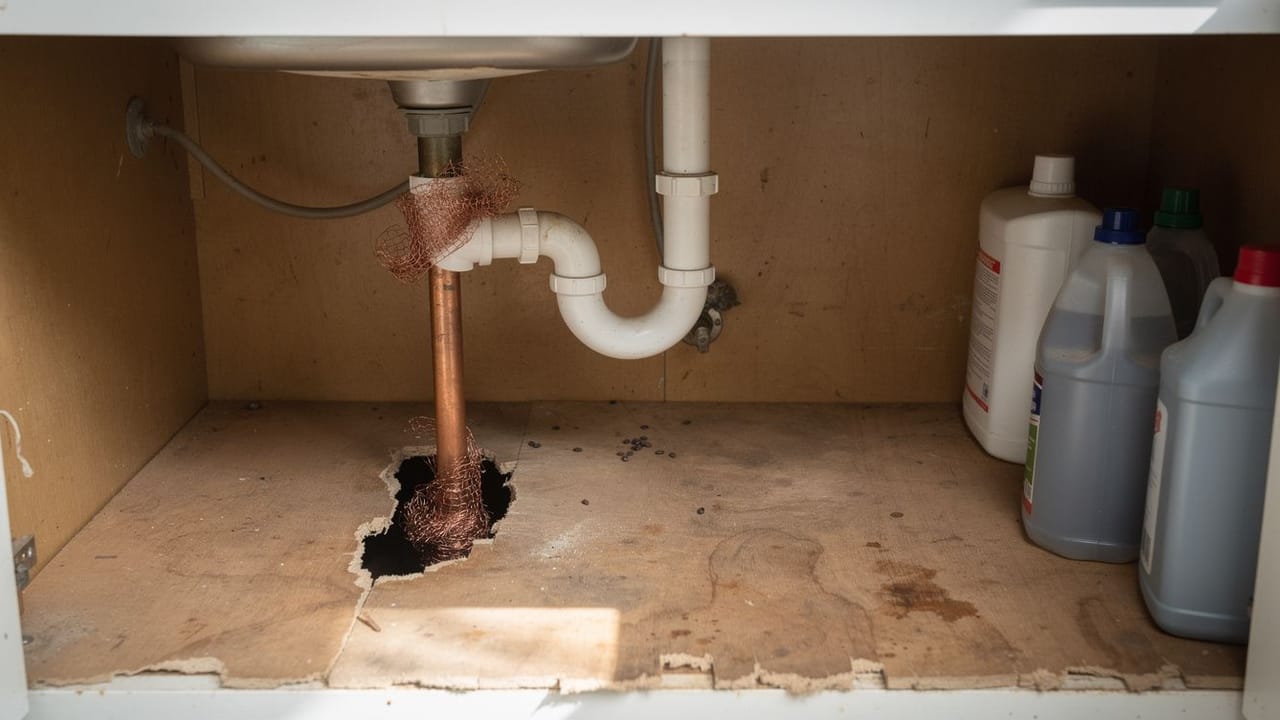
In older Nashville houses, gaps around plumbing under kitchen and bathroom cabinets are a frequent internal route from the crawl space. The same houses often have rats or squirrels in the attic as well; our post on scratching in the attic at night covers telling them apart by sound.
- Crawl space access and vents
- Rim joist and sill plate gaps
- Pipe, wire and duct penetrations
- Worn garage door bottom seal
- Gaps under sinks connecting to the crawl
What should you use to seal mouse holes?
Copper mesh or stainless wool packed into gaps and then sealed works, because they cannot gnaw through it. Expanding foam alone does not — UC IPM lists it with plastic, rubber and wood as gnawable and ineffective for plugging holes mice use.
Quarter-inch hardware cloth over larger openings and crawl space vents, fastened rather than pushed in; the Internet Center for Wildlife Damage Management’s house mouse chapter gives that mesh size for keeping mice out of a crawl space. Finding and closing every one of these is the work of our rodent exclusion service.
Where should mouse traps go?
Snap traps set perpendicular to walls with the trigger toward the wall, in the runs where droppings appear. University of Kentucky entomology’s ENTFACT-617 gives the same placement, because mice prefer to travel along walls and other edges.
Bait sparingly — a small smear works better than a large lump, which they can take without setting it off. If droppings keep turning up after a couple of weeks of trapping, there is a gap still open; ask us for a free estimate and we will walk the crawl space and the outside of the house to find it.
Sources
- CDC, Seal Up! Prevent Rodents — Mice fit through a hole the width of a pencil (1/4 inch)
- UC IPM, Rats Pest Notes (Publication 74106, updated 06/2025) — All holes larger than 1/4 inch sealed to exclude both rats and mice
- UC IPM, House Mouse Pest Notes (updated 07/2025) — Openings as small as 1/4 inch; climbing; steel wool; expanding foam is gnawable and ineffective; small amount of bait; mice enter in autumn as nights get colder
- Internet Center for Wildlife Damage Management, House Mouse Damage Prevention and Control Methods — Copper or stainless wool; quarter-inch hardware cloth for the crawl space
- University of Kentucky Entomology, ENTFACT-617: Control of Mice — Snap traps perpendicular to the wall, trigger end against it; mice travel along walls and edges
- University of Wisconsin Pesticide Applicator Training, Appendix: Rodent and Pest Bird Management — Where a young animal can squeeze its skull through, the body can generally follow
FAQ
Keeping Mice Out of a Nashville House — questions
How small a gap can a mouse get through?
About a quarter of an inch, roughly the diameter of a pencil. Extension guidance on rodents puts it this way: where a young animal can squeeze its skull through, the rest of the body can generally follow. That is why exclusion work has to be thorough — a gap that looks far too small is usually not.
Does expanding foam keep mice out?
On its own, no. They gnaw through it readily. Foam works as a sealant over a barrier they cannot chew, such as copper mesh, stainless wool or hardware cloth packed into the gap first. The barrier does the work and the foam finishes the seal.
Why do mice come in during autumn?
Colder nights push them to look for shelter, and a heated house with a crawl space underneath is ideal. Late autumn is when most Middle Tennessee homeowners first notice them, which makes late summer the right time to do exclusion work.
How do you know when mice are gone?
When fresh droppings stop turning up. If they keep appearing after a couple of weeks of trapping, a gap is still open somewhere, and the crawl space and the outside of the house are the places to look again: rim joist, pipe penetrations, vents and the garage door seal.